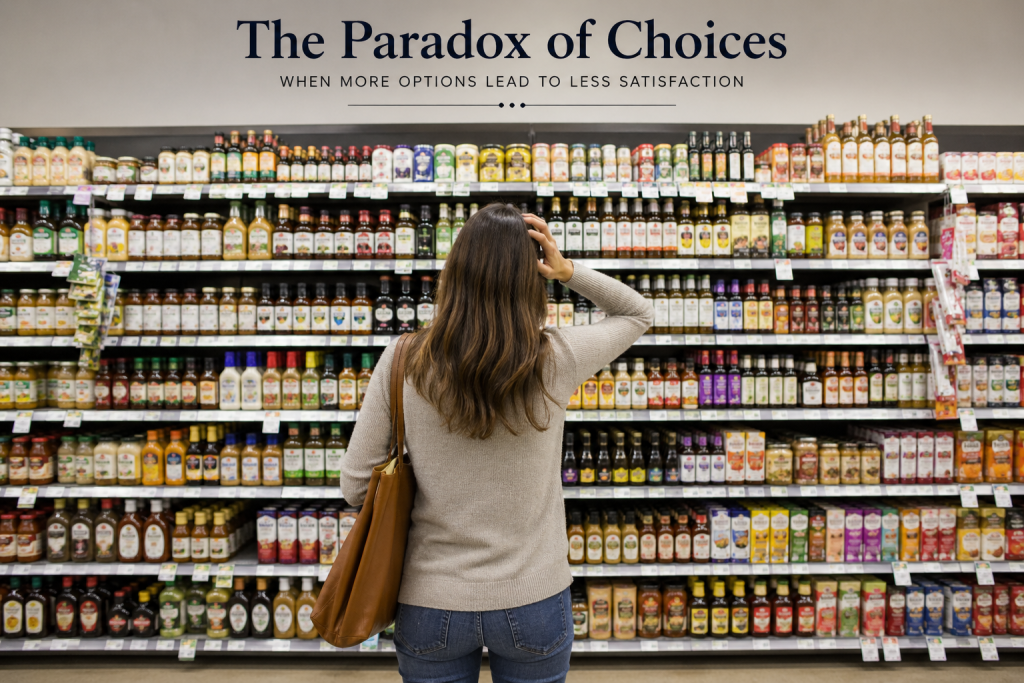
Picture this: You walk into a grocery store looking for jam. Instead of the three or four varieties you expected, you’re confronted with 24 different options. Strawberry, raspberry, blueberry, mixed berry, organic, sugar-free, artisanal, imported… The shelves blur together. Ten minutes later, you walk out empty-handed, overwhelmed and strangely exhausted.
This isn’t just about jam. This is about one of the most counterintuitive findings in modern psychology: more choice can actually make us less happy.
The Jam Study That Changed Everything
In 2000, psychologists Sheena Iyengar and Mark Lepper conducted what would become one of the most famous experiments in behavioral science. They set up a tasting booth in a California grocery store, alternating between displaying 24 varieties of jam and just 6 varieties.
The results were striking. While the larger display attracted more attention (60% of shoppers stopped to look versus 40% for the smaller display), the smaller selection led to dramatically more purchases. Only 3% of people who saw 24 jams actually bought one, compared to 30% who saw just 6 options.
Ten times more people made a purchase when presented with fewer choices.
Why Too Many Options Backfire
Our brains didn’t evolve to handle the sheer volume of decisions modern life throws at us. Research suggests several reasons why excessive choice becomes paralyzing:
Decision fatigue sets in when we’re forced to make too many choices. Each decision depletes our mental energy, leaving us less capable of making good choices later. This is why successful people like Steve Jobs and Barack Obama minimized daily decisions by wearing the same outfits—they were preserving cognitive resources for more important choices.
Opportunity cost anxiety increases with more options. When you choose one thing, you’re simultaneously choosing not to have everything else. With 24 jam options, selecting strawberry means forgoing 23 other potentially better choices. This creates a nagging sense that you might be missing out.
Maximizers suffer more than satisficers. Psychologist Barry Schwartz identified two types of decision-makers: maximizers who always seek the absolute best option, and satisficers who look for “good enough.” In a world of endless choice, maximizers are chronically dissatisfied because there’s always theoretically something better out there.
The tyranny of small differences makes trivial distinctions feel meaningful. When products are genuinely different, choice is helpful. But when we’re comparing 15 nearly identical options, we waste mental energy on distinctions that won’t actually impact our satisfaction.
The Happiness Cost
The paradox extends beyond purchasing decisions. Too much choice affects our well-being in surprising ways:
Studies of college students choosing courses found that those with more elective options were less satisfied with their choices than those with fewer options—even when they picked the exact same classes. The mere presence of alternatives made them question their decisions.
Research on speed dating shows that when people have more potential matches, they become more superficial in their evaluations, focusing on easily comparable qualities rather than deeper compatibility.
Even in career paths, analysis paralysis can be crippling. The modern worker faces thousands of potential career trajectories, and this abundance can lead to chronic dissatisfaction and delayed commitment.
Breaking Free from Choice Overload
Understanding the paradox of choice doesn’t mean eliminating all options. Instead, it’s about designing choice architectures that work with our psychology rather than against it:
Set constraints deliberately. Before a big decision, narrow your options to three to five finalists. This preserves meaningful choice while avoiding paralysis.
Embrace “good enough.” Practice satisficing for low-stakes decisions. The coffee you buy at the corner store doesn’t need to be absolutely optimal—it just needs to be good enough to enjoy.
Automate routine decisions. Create systems and defaults for recurring choices. Meal planning, capsule wardrobes, and subscription services all reduce daily decision-making load.
Separate exploration from decision. When researching options, set a time limit. Once time is up, commit to choosing from what you’ve found rather than continuing to search indefinitely.
Focus on what matters. Not all choices deserve equal mental energy. Save your decision-making capacity for choices that will genuinely impact your well-being.
The Freedom in Limits
There’s a beautiful irony here: constraints can be liberating. When options are limited, we spend less time deciding and more time enjoying. We second-guess ourselves less. We compare our choices less to idealized alternatives.
The next time you feel overwhelmed by options—whether it’s streaming services, career paths, or breakfast cereals—remember that your ancestors thrived with far fewer choices than you face before lunch on a typical Tuesday. Our brains are sophisticated, but they’re not infinite.
Sometimes, the path to greater satisfaction isn’t having more options. It’s having fewer, better ones—and the confidence to choose without looking back.
1 comment
A WordPress Commenter - April 27, 2026 4:27 am
Hi, this is a comment.
To get started with moderating, editing, and deleting comments, please visit the Comments screen in the dashboard.
Commenter avatars come from Gravatar.